AI Automation · Hackathon
Lumora.
AI Service Desk Command Center
An AI Service Desk Command Center that coordinates support tickets and incident response with human oversight.
- Role
- AI Employee developer
- Project type
- Hackathon prototype
- Team
- Lumora · 2 members
- Period
- 2026
Project overview
My teammate and I built Lumora as an AI Employee for the Supervity AutoPilot Asia Hackathon. Specialist operators handle different stages of service desk work, while an orchestrator coordinates their decisions and handoffs.
The problem
Repetitive tickets need triage and follow-up, especially when service-level targets are at risk. During major incidents, teams also need to coordinate investigation, approvals, and communication.
The solution
Bring ticket context into a shared workflow with specialist AI operators. Use policies to guide routing and escalation, keep people in charge of change approvals, and prepare incident updates for the support team.
What I built
AI Employee development
Co-built the service desk AI Employee with my teammate as part of Team Lumora.
How it works
Ticket Triage
Classify the request, assess its urgency, and check whether it needs escalation.
Diagnostic Analysis
Combine ticket history and relevant context into a structured diagnostic summary.
Orchestration
Coordinate operator handoffs, policy checks, and major incident routing.
Remediation
Define a path for eligible routine fixes and send changes that require approval to a person.
Verification
Compare the resulting ticket state with the expected outcome and flag exceptions for review.
Incident Communication
Prepare structured Slack updates for escalation, major incidents, and resolution.
AI Employee architecture
- Support contextSupabase stores the prototype’s ticket and service context.
- Orchestrator & operatorsSupervity Auto coordinates specialist operators and their handoffs.
- Policy & human reviewSLA checks guide escalation and people review approval-required changes.
- Incident updatesThe communication operator prepares support updates through Slack.
- Command CenterSupport staff can review approval decisions, AI policies, and service desk insights.
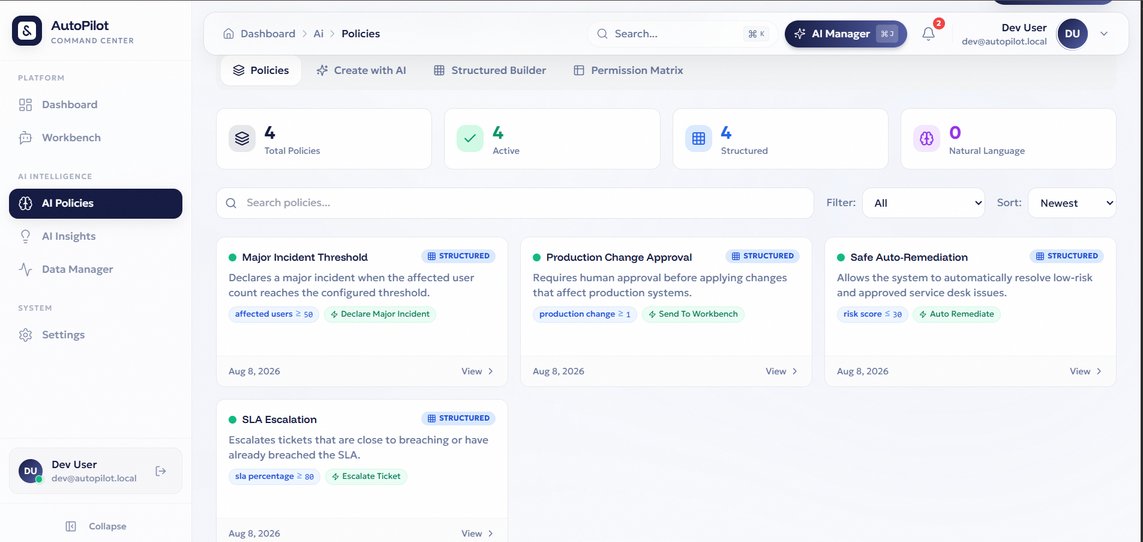
The competition prototype demonstrates the diagnostic flow, four governance policies, and a reviewed sample approval. The policies cover major incident detection, SLA escalation, change approval, and safe remediation. Controlled remediation and verification are downstream workflow stages in the design.
Hackathon journey
Supervity AutoPilot Asia Hackathon 2026
Asia Pacific University of Technology & Innovation (APU), Malaysia
The challenge was to build an AI Employee for an enterprise workflow. My teammate and I submitted a Stalled Ticket Resolver for the qualifying round and expanded it into a multi-operator service desk prototype for the grand finale on 8–9 August 2026.
Read the APU event recapEngineering decisions
Clear handoffs
Pass enough ticket context between operators for the team to understand what each stage decided.
Accountable escalation
Keep policy-driven steps and decisions requiring human approval visible throughout the workflow.
Prototype screenshots
The Command Center screens show hackathon sample data. The operator list and diagnostic workgraph show the Supervity setup.
Results & awards
Supervity AutoPilot Asia Hackathon 2026
- Team Lumora advanced to the Asia-level grand finale at APU, where finalists from across Asia-Pacific showcased their AI Employees.